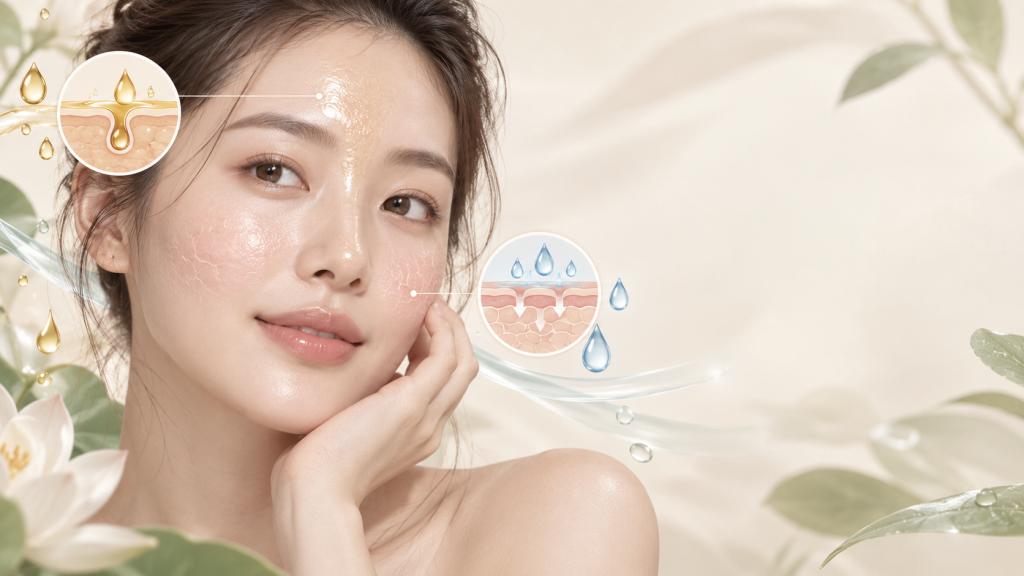
Oily-looking skin that still feels dry and tight – is this really possible?
It has not been long since you washed your face, yet your forehead, nose, and chin are already starting to look shiny. By midday, makeup may wear off easily and pores may appear more noticeable. Yet immediately after cleansing, your cheeks may feel tight, the skin surface may feel rough, or you may sometimes experience stinging.
It may sound contradictory, but oily skin and dehydrated skin can absolutely coexist.
Oily skin is primarily defined by the amount of sebum produced by the sebaceous glands. Oily skin, or seborrhea, occurs when the sebaceous glands produce large amounts of sebum, making the skin surface appear shiny and greasy.[1] Sebum and epidermal lipids also help maintain the skin surface and protective barrier, but the amount of oil on the surface does not correspond to the amount of water in the stratum corneum.[1]
Having a lot of oil does not mean the skin is adequately hydrated.
This is the first important point for proper skincare.
1. “Oily skin” and “dehydrated skin” are two different concepts
In skin science, sebum, skin hydration, and transepidermal water loss (TEWL) are different parameters.
Sebum reflects sebaceous gland activity. Meanwhile, stratum corneum hydration reflects the amount of water in the skin’s outermost layer, while TEWL describes the amount of water that diffuses through the stratum corneum and escapes into the environment.[2,3]
The stratum corneum is an important component of the skin’s permeability barrier. When the integrity of this barrier declines, TEWL often increases, which is why TEWL is widely used as an indicator of skin barrier function.[2,3]
This explains why we can have:
- oily and well-hydrated skin;
- oily but dehydrated skin;
- less oily and dehydrated skin;
- or less oily skin that still maintains relatively good hydration.
Sakuma and Maibach’s review of oily skin specifically notes that “dry skin” is not the opposite of “oily skin.” When discussing sebum levels, the distinction should be oily/non-oily; when discussing water content, the distinction should be dry/non-dry.[1]
This is also why Diamond Lotus does not recommend looking only at a shiny surface and concluding that the skin has “too much moisture.”
2. What happens when skin is dehydrated?
Water in the stratum corneum plays an important role in softness, flexibility, and normal skin barrier function.
The skin continuously loses a certain amount of water to the environment. This process is called transepidermal water loss (TEWL). TEWL is not sweat; it is the passive diffusion of water through the stratum corneum.[2–4]
When the skin barrier is damaged, TEWL may increase. When the environment, skincare habits, or other factors alter the amount of water in the stratum corneum, the skin may become:
- tight after cleansing;
- rough;
- less supple;
- prone to mild flaking;
- more prone to stinging or discomfort;
- makeup may not sit well even though the surface remains oily.
Research and skin-measurement guidelines also show that TEWL and hydration are affected by many factors, including temperature, environmental humidity, body site, skin washing, and the use of topical products.[2,4]
Therefore, “dehydrated skin” should be understood as a skin condition rather than a fixed lifelong “skin type.”
3. Does dehydrated skin produce more oil to “compensate for water loss”?
This is one of the most common explanations on social media, but it needs to be phrased more carefully.
Some consumer skincare guidance suggests that when skin becomes dry, oil production may increase and raise the risk of clogged pores.[9]
However, an in-depth review of sebaceous gland physiology shows that excessive face washing can dry the skin but does not necessarily mean the sebaceous glands will increase sebum production to “compensate for water loss.”[1] The authors identify this as one of the common misconceptions about oily skin.
Skin can be both dehydrated and oily at the same time, but it should not be assumed that every case of oily skin is a response of “producing oil to compensate for water loss.”
Sebum levels are also influenced by many other factors, including hormones, age, sex, genetics, climate, and possibly metabolic and nutritional factors.[1]
Understanding this helps us avoid a very common vicious cycle: seeing oil → cleansing more aggressively → making the skin drier and more irritated → continuing to use even harsher products.
4. Why can oily skin become dehydrated?
Cleansing too harshly or too frequently
Shiny skin makes many people want to wash their face repeatedly or choose a cleanser that creates a “squeaky-clean” feeling. But caring for oily skin does not mean removing all surface lipids.
The American Academy of Dermatology (AAD) recommends that people with oily skin wash their face up to about twice a day and after heavy sweating, avoid scrubbing, and choose a gentle cleanser.[8]
Experts in a 2023 review of acne and the skin barrier also note that harsh cleansing, topical alcohol, abrasive scrubs, and friction can increase irritation and inflammation.[5]
A tight, squeaky feeling after cleansing is not a sign that the skin has been cleaned better.
Using too many exfoliating products or active ingredients at once
Salicylic acid, glycolic acid, lactic acid, and many other active ingredients can be useful in an appropriate routine. However, the AAD also notes that oil-reducing active ingredients may be too harsh for some skin; if irritation develops, their use should be stopped or reduced in frequency.[8]
A routine that includes acids, retinoids, acne treatments, peels, and deep-cleansing products all at once can make it very difficult to identify the cause of irritation.
With skincare, more steps do not necessarily mean better results.
Air conditioning, heating, and low-humidity environments
This is a noteworthy factor for people who work in offices.
A study by Ohno and colleagues conducted in an air-conditioned environment at 24°C and 35% relative humidity used TEWL, skin conductance, and biomechanical parameters to assess facial skin. The study found that dry air conditions in an air-conditioned room were associated with changes in hydration parameters and the mechanical properties of the skin.[6]
A 2023 study in Korea also observed significant skin changes after just six hours in a heated winter environment: skin temperature, roughness, redness, and wrinkles increased on the face; on the forearm, hydration decreased and TEWL increased.[7]
However, studies on climate and TEWL are not entirely consistent. A systematic review by Green and colleagues concluded that the effects of season, temperature, and humidity on TEWL vary across studies.[4]
Therefore, it is not accurate to say that “being in air conditioning definitely dehydrates the skin.” A more reasonable statement is that dry environments, prolonged air conditioning, or heating may be among the factors that affect hydration and the skin barrier, particularly in people whose skin is already prone to dryness or sensitivity.
5. How can you tell if oily skin may be dehydrated?
No single sign is sufficient to self-diagnose this condition. You should observe the combination of oil levels, how the skin feels, and its surface condition.
Possible signs include:
- the T-zone becomes shiny quickly while the cheeks feel tight;
- cảm giác khô hoặc tight after cleansing;
- bề mặt sần, less supple;
- areas of mild flaking;
- skin stings more easily with products that were previously well tolerated;
- foundation may look cakey even though the skin becomes shiny again a few hours later;
- acne/clogged pores together with a feeling of dryness.
The skin barrier deserves particular attention in acne-prone skin. A 2023 review shows that acne-affected skin has changes related to the epidermal barrier, including increased sebum production but reduced levels of certain stratum corneum lipids, including ceramides.[5]
Oily skin + acne does not mean the skin does not need moisturizer.
6. How should dehydrated oily skin be cared for?
Step 1. Start with gentle cleansing
There is no need to try to remove all oil from the skin. The AAD recommends washing the face up to about twice a day and after heavy sweating; avoiding harsh scrubs; choosing a gentle cleanser; and avoiding cleansing products that cause irritation.[8]
If your skin frequently feels tight, stings, or flakes after washing, reassess your cleansing product and frequency.
Step 2. Moisturize – even if you have oily skin
This is often the step people with oily skin are most hesitant about. But moisturizer is not only for dry skin. The AAD recommends that oily skin still use moisturizer to maintain hydration; for acne-prone skin, products labeled oil-free, non-comedogenic, or won’t clog pores should be prioritized.[8,9]
For people using benzoyl peroxide, salicylic acid, retinoids, or isotretinoin, moisturizer may also help reduce treatment-related dryness and irritation.[9]
Studies and reviews of acne-prone skin also support the use of gentle, non-comedogenic cleansers and moisturizers to help maintain a healthy skin barrier.[5]
Step 3. Reduce treatment intensity when the skin is irritated
If your skin suddenly becomes redder, burns, stings, flakes heavily, or becomes noticeably more sensitive, do not rush to add a new product. Review the potentially irritating factors in your routine, especially exfoliants, alcohol, scrubs, retinoids, or multiple active ingredients used at the same time.[5,8]
A simple routine that can be maintained consistently is often more valuable than a complicated routine that the skin cannot tolerate.
Step 4. Do not skip sunscreen
The AAD recommends that people with oily skin still use sunscreen; for acne-prone skin, suitable non-comedogenic formulas may be preferred.[8]
Sun protection is not an “extra beauty” step; it is part of long-term skincare.
7. Do you need to buy lots of “hydrating” products?
Not necessarily.
“Hydration” is a fairly broad marketing term. What matters more is whether the routine helps to:
- keep the skin surface clean without making it overly dry;
- maintain an appropriate amount of water in the stratum corneum;
- limit irritation;
- support the skin barrier;
- avoid increasing clogged pores in acne-prone individuals.
A good product does not necessarily need a long list of active ingredients. For oily, acne-prone skin, gentle + non-comedogenic + easy to maintain can sometimes be more important than an overly ambitious routine.[5,8,9]
8. How long does it take for the skin to regain balance?
There is no single timeframe that applies to everyone. Skin condition varies depending on the products being used, the degree of barrier damage, the environment, any underlying skin conditions, and individual factors.
It is important to avoid changing the entire routine every few days. For acne-prone skin, the AAD also notes that the results of a routine with an appropriate moisturizer should not be judged after only a few days; in the studies they reviewed, improvement was generally monitored over several weeks.[9]
If a product causes clear redness, swelling, itching, burning, or other unusual reactions, that is a different situation: stop using it and seek professional advice when needed.
9. When should you see a dermatologist?
“Dehydrated oily skin” does not always explain every skin symptom. You should consider seeing a dermatologist if you have:
- significant or persistent inflammatory acne;
- pain, swelling, or cysts;
- persistent itching or redness;
- significant peeling;
- widespread lesions;
- suspected dermatitis or allergy;
- increasing dark marks and scarring;
- or no improvement despite adjusting your skincare.
The AAD also recommends that people struggling with oiliness, blackheads, or acne speak with a dermatologist rather than continuing uncontrolled product experimentation.[8]
| DIAMOND LOTUS NOTE
Don’t just ask: “Is my skin oily or dry?” A more useful question might be: “What does my skin need right now?” The same person may have an oily forehead and nose while the cheeks are drier. Skin condition can also change with the weather, work environment, hormones, products being used, and lifestyle habits. Therefore, at Diamond Lotus, skincare should begin with observing and assessing the skin’s actual condition rather than automatically applying the same regimen to everyone. Understand your skin before caring for it. Explore skincare experiences at Diamond Lotus → The information in this article is for beauty-care reference purposes only and does not replace diagnosis or treatment by a dermatologist. |
References
1. Sakuma TH, Maibach HI. Oily skin: an overview. Skin Pharmacol Physiol. 2012;25(5):227-235. doi:10.1159/000338978.
2. du Plessis J, Stefaniak A, Eloff F, John S, Agner T, Chou TC, et al. International guidelines for the in vivo assessment of skin properties in non-clinical settings: Part 2. Transepidermal water loss and skin hydration. Skin Res Technol. 2013;19(3):265-278. doi:10.1111/srt.12037.
3. Klotz T, Ibrahim A, Maddern G, Caplash Y, Wagstaff M. Devices measuring transepidermal water loss: a systematic review of measurement properties. Skin Res Technol. 2022;28(4):497-539. doi:10.1111/srt.13159.
4. Green M, Kashetsky N, Feschuk A, Maibach HI. Transepidermal water loss (TEWL): environment and pollution—A systematic review. Skin Health Dis. 2022;2:e104. doi:10.1002/ski2.104.
5. Schachner LA, Alexis AF, Andriessen A, Berson D, Gold M, Goldberg DJ, et al. Insights into acne and the skin barrier: optimizing treatment regimens with ceramide-containing skincare. J Cosmet Dermatol. 2023;22:2902-2909. doi:10.1111/jocd.15946.
6. Ohno H, Nishimura N, Yamada K, Shimizu Y, Iwase S, Sugenoya J, et al. Effects of water nanodroplets on skin moisture and viscoelasticity during air-conditioning. Skin Res Technol. 2013;19:375-383. doi:10.1111/srt.12056.
7. Park EH, Jo DJ, Jeon HW, Na SJ. Effects of winter indoor environment on the skin: unveiling skin condition changes in Korea. Skin Res Technol. 2023;29:e13397. doi:10.1111/srt.13397.
8. American Academy of Dermatology Association. How to control oily skin [Internet]. Schaumburg (IL): American Academy of Dermatology Association; updated 2024 Sep 3 [cited 2026 Sep 5].
9. American Academy of Dermatology Association. Moisturizer: Why you may need it if you have acne [Internet]. Schaumburg (IL): American Academy of Dermatology Association [cited 2026 Sep 5].
Diamond Lotus Wellness & Spa · Beauty & Wellness Journal