
Are all the small dots on your nose blackheads?
You look closely at your nose and see dozens of tiny gray, pale yellow, or slightly brown dots. When squeezed or removed with a pore strip, a thread-like substance may come out. The natural reaction is to think: “I have so many blackheads.”
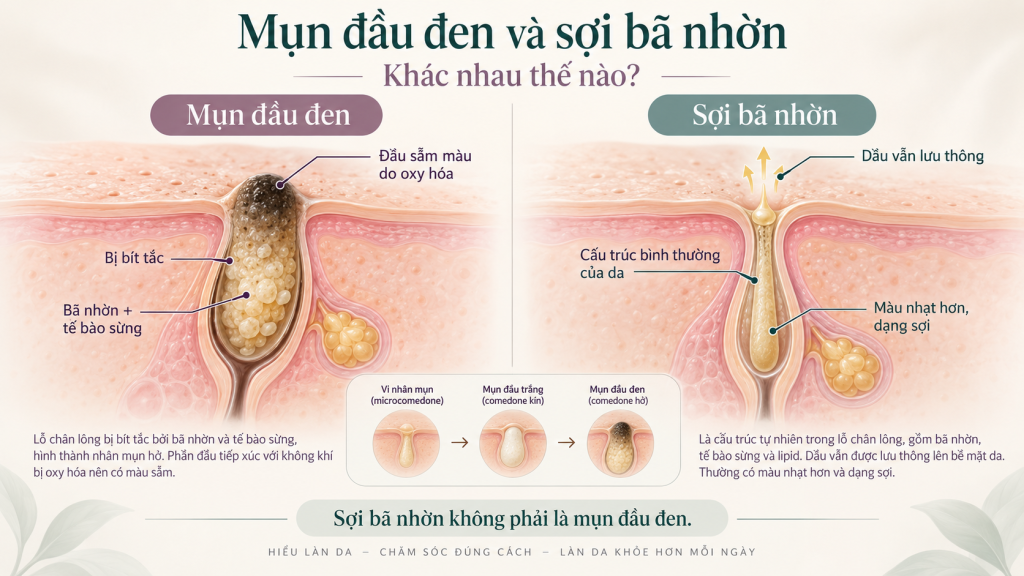
But not every small dot in a pore is a blackhead. Some of them may be sebaceous filaments – a common physiological structure of the pilosebaceous follicle, especially in the central face and around the sides of the nose.[1,2]
In contrast, a blackhead is a type of open comedone associated with acne. It is part of the acne-development process, which begins with microscopic changes in the pilosebaceous unit and may involve hyperkeratinization, sebum, Cutibacterium acnes, and inflammation.[3–6]
Distinguishing between these two conditions is important because the care goals are different: sebaceous filaments are not “dirt” that needs to be completely removed, while blackheads are acne lesions that may require an appropriate treatment strategy.
1. What are sebaceous filaments?
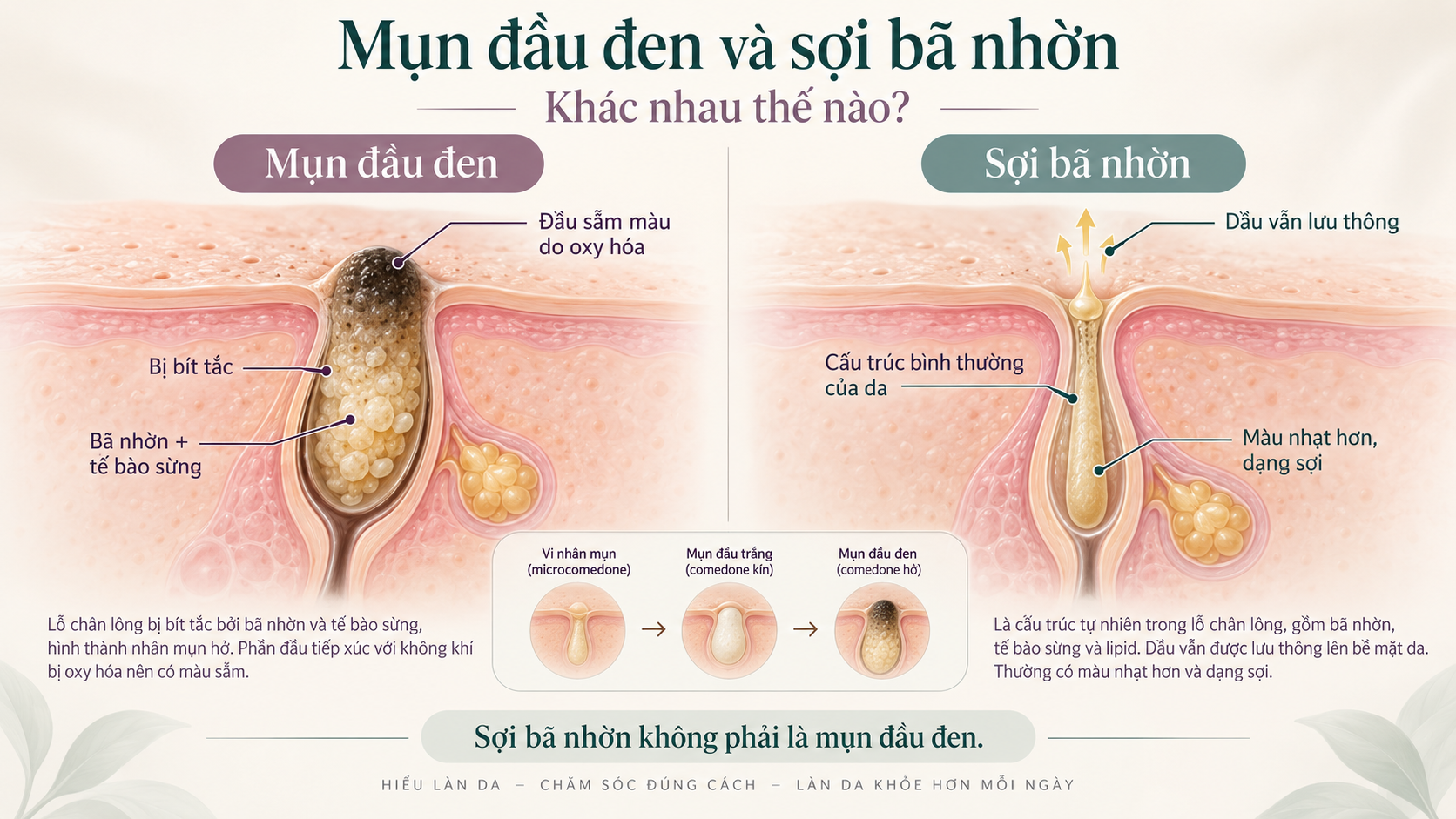
The classic study by Plewig and Wolff describes sebaceous filaments as cylindrical or thread-like, white-to-yellow structures commonly found in areas rich in sebaceous follicles, such as the central face and sides of the nose. Structurally, they consist of multiple layers of corneocytes surrounding a mixture of sebaceous lipids, keratinous debris, bacteria, and often a hair shaft.[1]
An important point: the authors regard sebaceous filaments as a common morphological variant of sebaceous follicles, not a pathological lesion. After removal, the follicle may refill within about 30 days.[1]
A 2021 dermoscopy report also describes ivory-white to pale-yellow thread-like structures with relatively uniform cylindrical shapes around hair follicles.[2] This matches their typical appearance: sebaceous filaments are usually small, fairly uniform, and densely concentrated on the nose, chin, forehead, or cheeks near the nose.
Cleveland Clinic also emphasizes that sebaceous filaments are a normal part of the skin and help carry sebum from the sebaceous glands to the surface. When sebum production is higher or follicular openings are more visible, they may become more noticeable cosmetically.[8]
2. What are blackheads?
A blackhead is an open comedone – a clinically visible, non-inflammatory acne lesion. Before becoming a comedone visible to the naked eye, the process usually begins microscopically with a microcomedo.[3,4]
Cunliffe and colleagues describe comedogenesis as involving hyperkeratinization within the pilosebaceous duct: keratinocytes proliferate and are retained in the follicular duct, forming a comedonal plug. The study also notes that the number and size of microcomedones are associated with acne severity.[3]
The 2024 review by Xie and colleagues – also among the materials you provided through full-article screenshots – considers the microcomedo an early stage in the acne lesion cycle. The review describes four prominent groups of factors: abnormal proliferation/keratinization of the follicular duct, changes in sebum, C. acnes, and the inflammatory response. From a microcomedo, the lesion may progress into a visible comedone, and some may continue to develop into papules or pustules.[4]
Clayton and colleagues’ review of the sebaceous gland also shows that acne is not simply a matter of “oily skin.” Comedones are associated with changes in the pilosebaceous unit, keratinocyte differentiation, and the composition/activity of the sebaceous gland.[5]
3. Quick comparison: blackheads vs. sebaceous filaments
| Characteristic | Sebaceous filaments | Blackheads |
| Nature | A physiological structure of sebaceous follicles; not acne.[1,8] | Open comedone – a type of acne lesion.[3,6,8] |
| Typical appearance | Small, fairly flat, and uniform; white-yellow, gray, or light brown.[1,2,8] | A more distinct comedonal plug, with an open follicular opening and a darker surface.[3,8] |
| Distribution | Usually numerous and fairly uniform on the nose, central face, and chin.[1,8] | May appear scattered or clustered in acne-prone areas such as the face, chest, and back.[6,7] |
| When extracted | May produce a thread-like, soft/waxy material; the follicle will gradually refill.[1,8] | A keratin–sebum plug may be seen.[8] |
| Care goal | Reduce their visibility; do not aim to “eliminate them permanently.” | Control comedogenesis and prevent new acne lesions.[4,6] |
The table above is only a general guide. In practice, sebaceous filaments and blackheads can coexist on the same face, and visual inspection alone is not always sufficient to distinguish them with certainty.
4. Why are they easily confused?
Both appear in areas rich in sebaceous glands
The nose, forehead, and chin contain many pilosebaceous units. Therefore, both sebaceous filaments and comedones are easily noticed in these areas.[1,5,8]
Both can look like “dots inside the pores”
Up close, a gray or light-brown sebaceous filament can look like a very small blackhead. Cleveland Clinic notes that sebaceous filaments are generally smaller, flatter, and lighter in color than blackheads, but this is not an absolute rule.[8]
Squeezing or using pore strips creates the feeling of having “cleaned out the pores”
When a pore strip pulls out many thread-like structures, it is easy to interpret all of them as acne. However, histological research shows that sebaceous filaments are normal structures of sebaceous follicles and can reform after being removed.[1]
5. Why do blackheads form?
Blackheads should not be explained simply as “dirt trapped in the pores.” In acne, multiple biological processes occur simultaneously.
Abnormal keratinization within the follicle
Comedones form when keratinocytes within the follicular duct proliferate/differentiate abnormally and are retained, creating conditions for microcomedones to develop.[3–5]
Sebum and lipid composition
Acne is often accompanied by increased sebum production and changes in lipid composition. However, oil levels alone do not explain the entire process; the interactions among lipids, keratinocytes, and biological signaling within the pilosebaceous unit are what matter.[3,5]
Cutibacterium acnes and inflammation
Modern research shows that C. acnes and the inflammatory response may become involved very early in the acne cycle, even before clearly inflammatory lesions appear. A 2023 review by Cruz and colleagues summarizes four major pillars of acne pathogenesis: sebum, follicular hyperkeratinization, C. acnes, and the immune-inflammatory response.[9]
6. Should you squeeze sebaceous filaments or blackheads?
For sebaceous filaments, frequent squeezing does not address the underlying issue because they are normal structures and the follicles will gradually refill. Plewig and Wolff observed this process occurring within about 30 days after a filament was removed.[1] Cleveland Clinic also advises against squeezing forcefully with the fingernails because this can cause irritation or skin damage.[8]
For blackheads, forceful self-extraction is not an ideal option either. Uncontrolled pressure can damage the skin surface, cause irritation, and leave post-inflammatory marks. If comedones are numerous, persistent, or accompanied by inflammatory acne, a more appropriate approach is to assess the overall acne condition and choose an evidence-based treatment.
Pore strips may create an immediate “clean” effect, but they can also pull out sebaceous filaments. Because sebaceous filaments are not pathological, repeatedly trying to remove them should not be a long-term skincare goal.[8]
7. What should at-home care focus on?
Step 1. Cleanse gently and consistently
The goal is to remove dirt, makeup, and excess surface oil without turning the routine into an attempt to “strip the pores clean.” Overly harsh cleansing can increase irritation and make acne active ingredients harder for the skin to tolerate.
Step 2. Maintain moisturization and choose non-comedogenic products
Skin with comedones still needs a routine that supports the skin barrier. Cleveland Clinic recommends gentle cleansing, moisturizing, and prioritizing non-comedogenic products for daily care.[8]
Step 3. Salicylic acid can be helpful – but more is not necessarily better
The American Academy of Dermatology’s 2024 guideline includes salicylic acid as a conditionally recommended treatment for acne.[6] Because of its effects on the stratum corneum and clogged pores, salicylic acid is commonly used in products for comedonal skin. Cleveland Clinic also mentions salicylic acid as an option that may help make sebaceous filaments less noticeable.[8]
This does not mean acids should be used at high frequency or that multiple exfoliants should be combined at once. If the skin becomes red, sore, flaky, or stingy, reduce the intensity and reassess the routine.
Step 4. For comedonal acne, topical retinoids have stronger evidence
The AAD 2024 guideline strongly recommends topical retinoids for acne management. The guideline describes retinoids as a cornerstone of topical treatment because of their comedolytic and anti-inflammatory effects and their role in maintaining acne control.[6] The AAD’s patient guidance also states that topical retinoids can help unclog follicles and treat blackheads/whiteheads.[7]
Retinoids can cause irritation and have specific precautions, so if you are pregnant, have an underlying skin condition, use multiple treatments, or have moderate-to-severe acne, you should consult a dermatologist before building a treatment routine on your own.
Step 5. Be patient with the skin’s cycle
Acne does not change after only one or two uses of a product. The AAD notes that people treating acne generally need at least about 6–8 weeks before they begin to see a reduction in lesions.[7] Changing products every few days often makes it harder to evaluate effectiveness and tolerance.
8. Common mistakes
- Assuming every dot on the nose is a blackhead and trying to squeeze them all out.
- Using pore strips repeatedly because you like the feeling of “pulling out lots of plugs.”
- Combining scrubs, BHA/AHA, retinoids, and acne treatments at the same time even when the skin is irritated.
- Skipping moisturizer because you think oily or acne-prone skin does not need hydration.
- Changing products too quickly before allowing enough time to evaluate them.
- Continuing self-treatment for too long despite inflammatory acne, deep lesions, pain, scarring, or increasing hyperpigmentation.
9. When should you see a dermatologist?
You should consider professional advice when:
- you are unsure whether the lesions are blackheads, sebaceous filaments, or another condition;
- comedones are numerous or persistent despite appropriate care;
- papules, pustules, nodules, pain, or swelling develop;
- scarring or post-acne dark marks begin to increase;
- the skin has persistent redness, soreness, or peeling due to treatment;
- you need to use a retinoid or acne treatment regimen but are pregnant, planning pregnancy, or have another skin condition.
The AAD emphasizes that effective treatment begins with an accurate diagnosis because conditions such as folliculitis or perioral dermatitis can be mistaken for acne.[7]
| DIAMOND LOTUS NOTE Do not set the goal of having “pores with absolutely no visible dots.” Healthy skin still has sebaceous glands, hair follicles, and sebaceous filaments. What matters more is distinguishing normal physiological features from acne lesions that need to be controlled. At Diamond Lotus, skincare should begin by observing the actual condition of each skin area, including oiliness, congestion, sensitivity, and the skin barrier – rather than assuming every dot on the nose needs to be “squeezed clean.”Understand correctly before deep cleansing. |
Explore skincare experiences at Diamond Lotus →
The information in this article is for beauty-care reference purposes only and does not replace diagnosis or treatment by a dermatologist.
References
1. Plewig G, Wolff HH. Sebaceous filaments. Arch Dermatol Res. 1976;255(1):9–21. doi:10.1007/BF00581673.
2. Singh Y, Neema S, Bahuguna A, Dabbas D. Sebaceous filaments. Dermatol Pract Concept. 2021;11(1):e2021148. doi:10.5826/dpc.1101a148.
3. Cunliffe WJ, Holland DB, Jeremy A. Comedone formation: etiology, clinical presentation, and treatment. Clin Dermatol. 2004;22(5):367–374. doi:10.1016/j.clindermatol.2004.03.011.
4. Xie L, Hamblin MR, Zheng D, Wen X. The role of microcomedones in acne: Moving from a description to treatment target? J Dtsch Dermatol Ges. 2024;22(1):9–16. doi:10.1111/ddg.15272.
5. Clayton RW, Göbel K, Niessen CM, Paus R, van Steensel MAM, Lim X. Homeostasis of the sebaceous gland and mechanisms of acne pathogenesis. Br J Dermatol. 2019;181(4):677–690. doi:10.1111/bjd.17981.
6. Reynolds RV, Yeung H, Cheng CE, et al. Guidelines of care for the management of acne vulgaris. J Am Acad Dermatol. 2024;90(5):1006.e1–1006.e30. doi:10.1016/j.jaad.2023.12.017.
7. American Academy of Dermatology Association. Acne: diagnosis and treatment [Internet]. Rosemont (IL): American Academy of Dermatology Association; [cited 2026 Sep 8]. Available from: https://www.aad.org/public/diseases/acne/derm-treat/treat
8. Cleveland Clinic. Sebaceous filaments: difference from blackheads & treatment [Internet]. Cleveland (OH): Cleveland Clinic; updated 2023 Jan 4 [cited 2026 Sep 8]. Available from: https://my.clevelandclinic.org/health/diseases/24571-sebaceous-filaments
9. Cruz S, Vecerek N, Elbuluk N. Targeting inflammation in acne: current treatments and future prospects. Am J Clin Dermatol. 2023;24(5):681–694. doi:10.1007/s40257-023-00789-1.
Diamond Lotus Wellness & Spa · Beauty & Wellness Journal